Learning Center

SEMI Standards Learning Hub

Practical equipment, GEM300, AMHS, and safety profiles with sourced explainers.

Explore three adoption profiles, then open original educational summaries for all 16 named standards. Fab specifications and equipment scope always determine applicability.

Educational summaries only. Use the current purchased SEMI documents and project requirements for implementation and conformance decisions.

Core SEMI standards profiles

Profile 1 · Communications foundation

200 mm Tool Standards

A practical modern SECS/GEM foundation: SECS-II message content, GEM equipment behavior, and HSMS network transport. E4 remains relevant where an installed factory requires legacy serial transport.
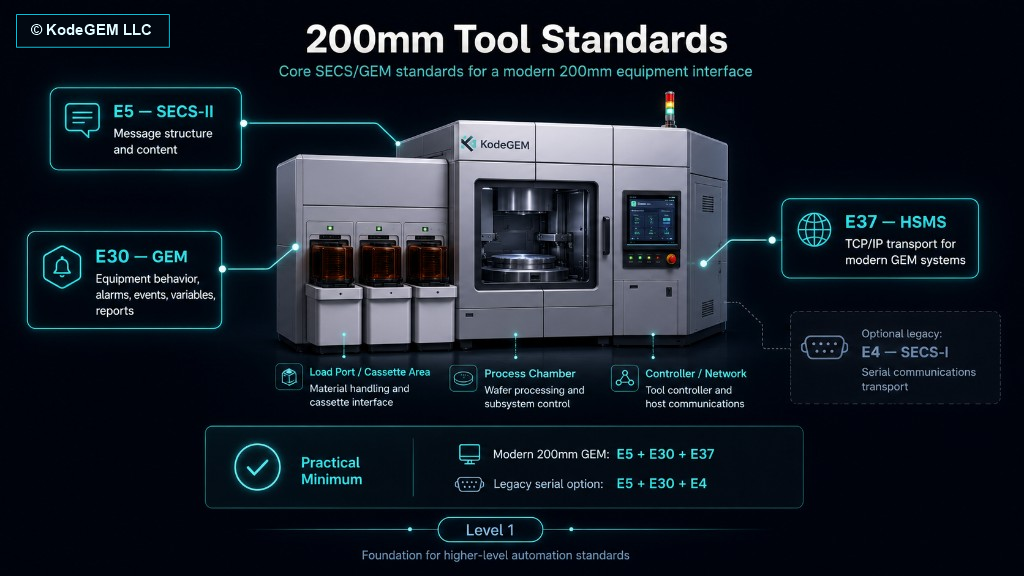
Applicability: This is a practical interface profile, not a wafer-size mandate. Customer specifications and the installed host determine the actual transport and GEM capabilities.

Profile 2 · GEM300 equipment automation

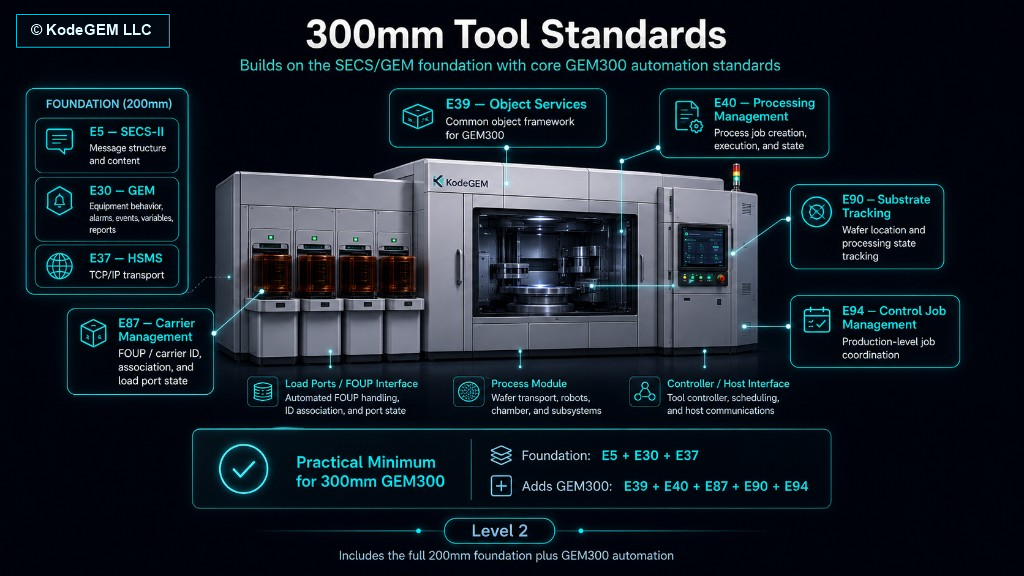
300 mm Tool Standards

The communications foundation plus a focused GEM300 core for host-visible objects, process jobs, carriers, substrates, and control jobs.

Applicability: GEM300 standards are not physically limited to one wafer diameter, and this focused profile is not exhaustive. Fab requirements may add E116, reticle, mapping, or other standards.

Profile 3 · Tool and AMHS ecosystem

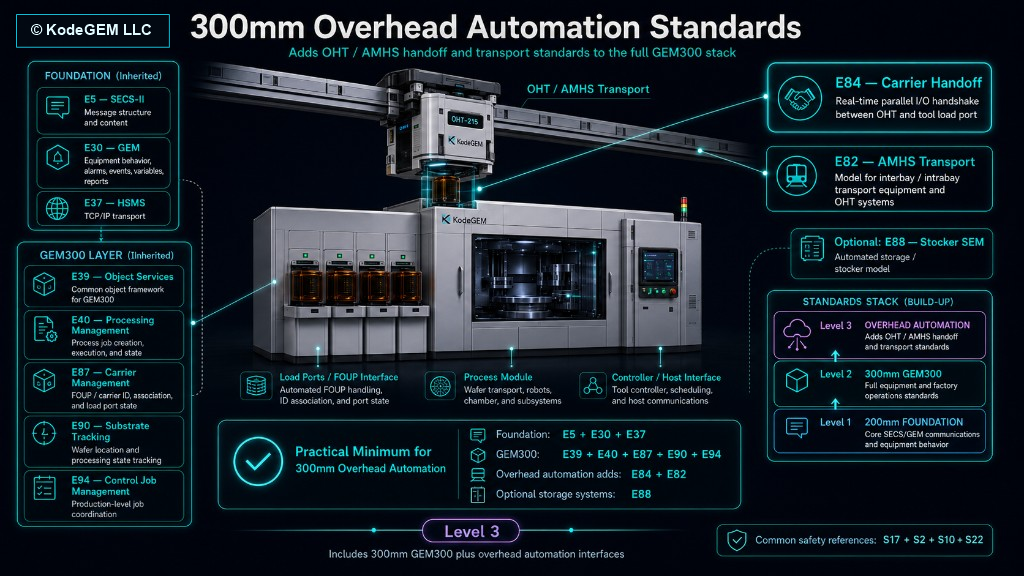
300 mm Overhead Automation

An ecosystem view that adds local carrier-handoff and AMHS equipment models around a GEM300 process tool, with common safety references for overhead transport projects.

Applicability: Responsibilities are distributed: the process tool commonly implements E84 at its load port, while E82 and E88 describe transport and stocker equipment. Confirm every boundary with the fab and AMHS suppliers.

Fab system context

How an AMHS fits together

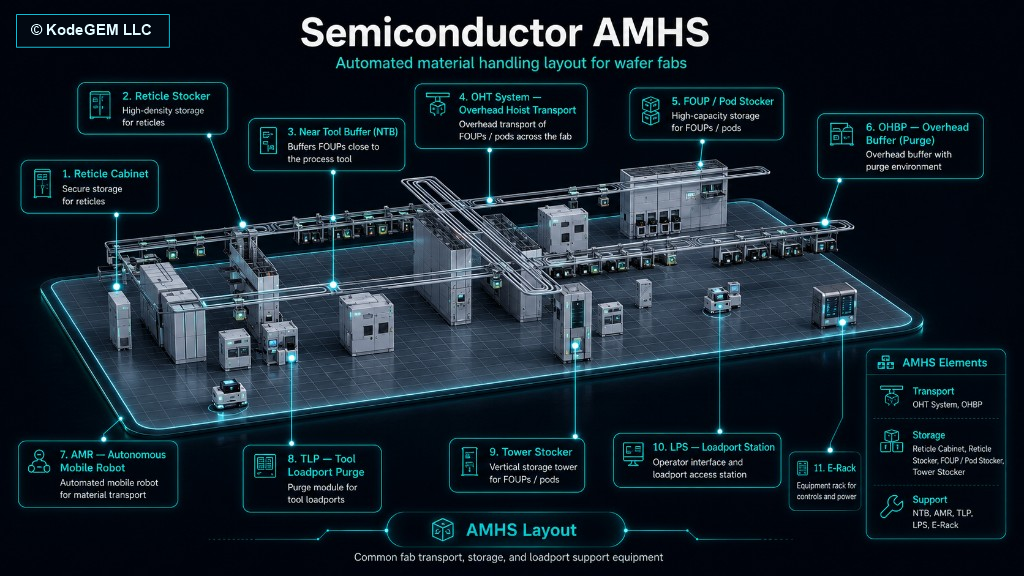
Automated material handling is a factory-wide ecosystem, not a single machine. This overview identifies common transport, storage, load-port, purge, operator, and support equipment found around semiconductor production tools.

Illustrated semiconductor fab AMHS layout identifying a reticle cabinet, reticle stocker, near-tool buffer, overhead hoist transport, FOUP and pod stocker, overhead purge buffer, autonomous mobile robot, tool load-port purge, tower stocker, load-port station, and equipment rack.
System boundary: The fab, AMHS supplier, stocker supplier, and process-equipment supplier divide responsibility across these elements. Actual equipment names, interfaces, and required standards are project specific.

Transport

OHT and mobile-robot systems move carriers between stockers, buffers, and production equipment. E82 describes a host-facing model for qualifying AMHS transport equipment.

Storage and handoff

Stockers and near-tool buffers stage material. E88 addresses stocker equipment, while E84 coordinates the local carrier handoff at applicable equipment boundaries.

Safety and integration

Overhead movement, suspended loads, maintenance access, electrical systems, and recovery procedures require coordinated equipment and fab safety engineering.

Find implementation evidence by SEMI standard

Search a standard such as E5 or E127 to find identified evidence for PDF Solutions Cimetrix products, PEER Group products, and KodeGEM project experience.

Search framework and project evidence →

Published standard explainers

SEMI E4 — SECS-I

Published

SEMI E4 defines the legacy serial transport used to move SECS messages between equipment and a factory host. It remains relevant when modernizing installed tools that still communicate through an RS-232-class link.

Open →

SEMI E5 — SECS-II

Published

SEMI E5 defines SECS-II message structure, data item formats, streams, and functions used by intelligent manufacturing equipment and factory hosts. It is the common message language beneath GEM and GEM300.

Open →

SEMI E30 — GEM

Published

SEMI E30 defines the externally visible behavior expected from GEM equipment, including communication, control, state, data collection, alarms, variables, recipes, terminal services, and remote commands.

Open →

SEMI E37 — HSMS

Published

SEMI E37 defines the TCP/IP transport commonly used for SECS-II traffic, including session selection, data messages, control transactions, timers, system bytes, and connection recovery.

Open →

SEMI E39 — Object Services

Published

SEMI E39 supplies shared object concepts and services used by GEM300 models. It provides a consistent way to identify objects, expose attributes, and perform common object operations through the equipment interface.

Open →

SEMI E40 — Processing Management

Published

SEMI E40 models process jobs: the material to process, the recipe or process program to apply, execution state, and host services used to create and control production work.

Open →

SEMI E82 — IBSEM

Published

SEMI E82 defines a host-visible specific equipment model for interbay and intrabay automated material handling transport equipment, including transport commands, controller behavior, state, reports, and material movement.

Open →

SEMI E84 — Carrier Handoff

Published

SEMI E84 defines the parallel I/O handshake used during automated carrier load and unload operations between active AMHS equipment and passive equipment such as a process-tool load port.

Open →

SEMI E87 — Carrier Management

Published

SEMI E87 models carriers and load ports, including carrier arrival, identification, slot-map verification, access, association, transfer state, and the host-visible services surrounding those activities.

Open →

SEMI E88 — Stocker SEM

Published

SEMI E88 defines a host-visible specific equipment model for automated material handling storage equipment, including stocker controller, transfer command, carrier, crane, state, alarm, event, and reporting behavior.

Open →

SEMI E90 — Substrate Tracking

Published

SEMI E90 defines a consistent host-visible model for substrate identity, location, state, and movement through equipment, from carrier slots through internal handling and processing locations.

Open →

SEMI E94 — Control Job Management

Published

SEMI E94 defines control jobs that supervise one or more process jobs, their execution order, material selection, and post-processing destination within a GEM300 equipment interface.

Open →

SEMI S2 — Equipment EHS

Published

SEMI S2 is a broad environmental, health, and safety guideline for semiconductor manufacturing equipment. It is a safety reference, not a host communication or GEM300 interface protocol.

Open →

SEMI S10 — Risk Assessment

Published

SEMI S10 describes a structured process for identifying hazards, estimating and evaluating risk, selecting controls, and documenting residual risk for semiconductor manufacturing equipment.

Open →

SEMI S17 — UTV Safety

Published

SEMI S17 addresses safety considerations for unmanned transport vehicle systems, including floor-traveling and overhead systems used to move material in semiconductor and display manufacturing environments.

Open →

SEMI S22 — Electrical Design Safety

Published

SEMI S22 provides electrical-design safety guidance for semiconductor manufacturing equipment. It is relevant to process equipment and AMHS electrical systems but does not define SECS/GEM communication behavior.

Open →

Need help implementing any of these concepts?

KodeGEM provides professional consulting for:

  • SECS/GEM
  • Tool Control Software
  • Factory Integration
  • Motion Control
  • Vision
  • Robotics
  • Equipment Modernization
Schedule a Consultation