Working 3D Models
Digital Twins of semiconductor tools and experiment benches you can run — not just a render.
Working 3D models of semiconductor tools and experiment benches — including physics, chemistry, mathematics, and real hardware.
The point of a Digital Twin is that you can make mistakes without having to scrap real hardware. Run the model, change the environment or the previous process step, then deploy what works onto the equipment.
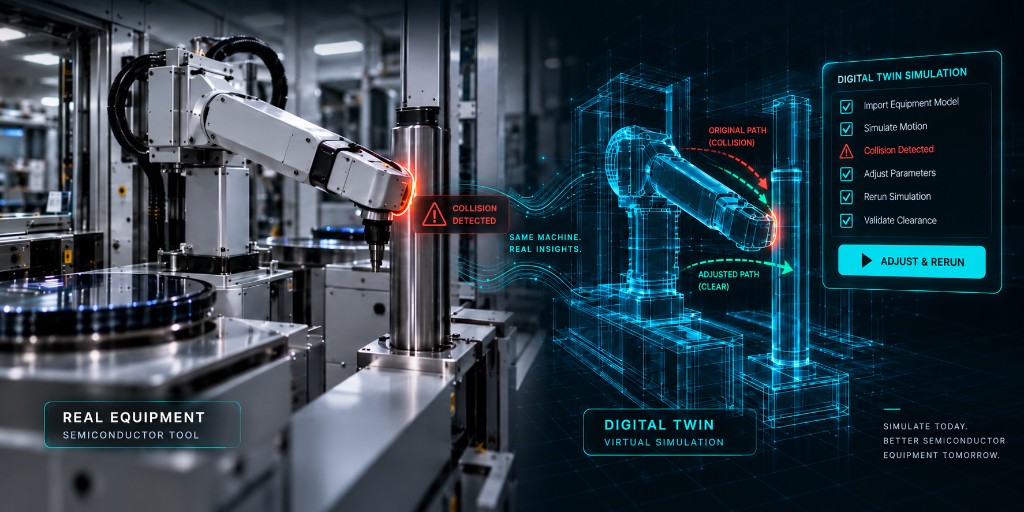
Create a working Digital Twin of the tool or bench. Make the mistakes there — then deploy what works onto the real equipment.
Digital Twins of semiconductor tools and experiment benches you can run — not just a render.
The model includes the physical, chemical, and mathematical behavior that makes the twin useful.
Connect the Digital Twin to real equipment so the model and the tool stay aligned.
The whole point of a Digital Twin is that you can make mistakes without having to scrap real hardware.
The substrate arriving at this tool already carries the previous step. Change cooling, chemistry, humidity, or incoming state and this twin’s output moves. Twins can pass that state to the next twin.
We take your GLB model, BOM, and process information and assemble a twin on reusable Digital Twin components we have built in house, driven by our AI engine. Proprietary files stay under NDA and on encrypted networks.
Looking ahead — not as a current product — connected twins are how a Digital Twin of the FAB would grow: add or remove tools and examine the product by changing the line.
Consulting on how to adopt AI at your semiconductor company and how to implement it — one portal, a safety check, and a local path for private work.
Staff open a company AI website and ask a question. They do not take customer files to personal ChatGPT.
Every question is checked before it can leave the building. Private work stays local. General knowledge may go public.
Email follow-ups, allowed documents, service drafts, and industry news — with a human still reading anything that goes to a customer.
A champion, a short written rule, a small pilot, then the portal and the always-on local path so work continues if a public model is cut off.
Digital Twin creation and deployment, and Company AI Solutions for semiconductor staff.
Working 3D models of lithography tools and experiment benches — including physics, chemistry, mathematics, and real hardware. We take your GLB, BOM, and process information and assemble a twin on the KodeGEM Digital Twin Component Library. Environment and previous-process state can change the output; a Digital Twin Network can pass that state to the next twin.
Working 3D models of lithography tools and experiment benches — including physics, chemistry, mathematics, and real hardware. We take your GLB, BOM, and process information and assemble a twin on the KodeGEM Digital Twin Component Library. Environment and previous-process state can change the output; a Digital Twin Network can pass that state to the next twin.
Consulting on how to adopt AI at your semiconductor company and how to implement it: one staff portal, a safety check on every question, and a local path for private work.
Create Digital Twins of your equipment and adopt Company AI for your staff — without building a full in-house program first.
Use Digital Twins to try ideas before they touch production hardware, and bring Company AI to the people who support the fleet.
Directors, software managers, and CTOs who need experienced tool-control engineers — not a slide deck.
Free and project utilities that sit beside Digital Twin and Company AI work.
Free Windows SECS/GEM Factory Host emulator and MCP Factory Host. One script is free to use.
Download SecsHost →Observe configured SECS/GEM activity, alarms, events, and equipment state as a standalone utility.
Open Live Monitor →
Keep the mistakes off the real hardware.
Digital Twin creation and deployment — including environment and previous-process context — Company AI Solutions for your staff, and SECS/GEM utilities, including free SecsHost for Windows.